 Tomorrow is Remembrance Day. It’s the first Remembrance Day of my life that I will not be celebrating with my grandfather, Murray Anderson, a veteran of the Second World War who passed away last winter.
In December, 2009, I scanned a number of pictures he took during his time in the Royal Canadian Navy with the intention of uploading them to honour today. Unfortunately I cracked the motherboard of the computer containing those scanned pictures last spring, and I haven’t managed to recover the harddrive yet. When I do, you can be sure I’ll upload them to this blog.
In the meantime, I want to put something up here in his memory, and to mark this day where we remember all those who have served and sacrificed in the past and present so that we can live in a better world. On my facebook profile I have a collection of photos of his ship that I’ve found online up, and so I’ll republish them here for a wider audience.

This is my grandfather’s ship, the HMCS Dumheller (K167). Of the 37 U-Boats destroyed by the Canadian Navy during the Second World War, it sank one and assisted in sinking another. It also served in Operation Neptune, the naval component of Operation Overlord, the Allied Invasion of Europe.
My grandfather was one of the wireless operators aboard the HMCS Drumheller. His ship escorted the Mulberry hulks, old wrecks that were scuttled off the D-Day beaches to make breakwaters and piers so the Allies could use the Normandy beaches as a port.
On June 6th the HMCS Drumheller was just offshore. He could see bodies floating in the water. He told me he saw a troopship, its deck full of soldiers, hit a mine and vanish in a flash of light and white water. Later that day he was out on the deck when the HMS Norfolk was firing its eight-inch guns inland against Nazi positions. He burst his eardrum and permanently lost his hearing in his right ear. He never reported the injury for fear of being put ashore, and it wasn’t until the 1980s that he filed a claim with veterans affairs. He was afraid he was going to get in trouble somehow for concealing his war wound for so long.

This is the HMCS Drumheller coming into a harbour. This photo was taken from the deck of a Canadian destroyer. See the sailors lined up on the deck? During the run up to D-Day it worked alone, shepherding individual ships from British port to British port along the English Channel.
One night he said they were escorting an American merchantman through the English Channel, and they could hear over the water the special whine of a German E-Boat (a torpedo boat that was easily a match for the Drumheller). The Canadians were hoping that the Germans wouldn’t find them, but the Americans had a 50-calibre machine gun bolted to their bow, and they started firing wildly into the night. All of a sudden my grandfather heard the ‘Ping! Ping! Ping!’ as the bullets bounced off the metal of the E-Boat. The Germans revved up their engines, turned tail and ran. He figures they must have thought anyone with the nerve to shoot at them must have been another torpedo boat. The Americans trigger-happy attitude saved the day.
My grandfather told me once they were in Portsmouth, and V-1 Buzz Bombs were flying overhead. All the ships in the harbour were firing their anti-aircraft guns, and then the orders came over the radio from the harbour master to cease fire immediately: If any of the V-1s were shot down, they could have hit one of the ammunition ships. The RAF would take care of them once they were in land.

Drumheller (K167) is on the far left there. This was a pretty standard docking arrangement for little ships, my grandfather said. Sometimes you’d have to walk across four or five ships to get to the pier. It could be a little tricky at night figuring out which ship was yours.

Here’s another good shot of the HMCS Drumheller. She was one of the Flower Class corvettes, based on the design of Norwegian whalers, little boats that could take rough Atlantic seas. She was armed with a four-pounder gun, depth charges, a hedgehog (which is an anti-submarine multi-shot mortar) and anti-aircraft guns. My grandfather said they weren’t the worst ocean-going ship in the Canadian navy: Sailors on corvettes pitied the men assigned to minesweepers, which were smaller still.

This was the HMCS Drumheller in late ’41 early ’42, before my grandfather served on her. Notice how short the f’oc’sle is? Well, sailors noticed. In rough seas, the waves could sweep right over her. In November 1943 she put into New York City for refits to make her taller and better able to take bad weather. Most of the crew got to go home for a month of two, but my grandfather (as one of the junior men) had to stay behind as a fire picket. He said it was his favourite memory of the war: For four hours a day he made sure the empty metal ship didn’t burn to the waterline (pretty easy work), and twenty hours a day he had the run of New York City, with free steak and real eggs for service men, along with passes to all the Broadway shows.

This is one of Tom C. Wood‘s most famous paintings. It’s called, ‘HMCS Drumheller’s Quarter Deck at Sea.’ Do you see what I mean about rough weather? The date reads 1944, so my grandfather was definitely aboard at this time. He was a radio operator, but his other action station was loading the depth charge you see on the rack at the left of the painting. How incredible is that, that they have my grandfather’s action station in a famous painting hanging in the Canadian War Museum? I told him I had found Tom Wood’s works, and he said, “Oh, yeah. I remember we had a war artist on board for one of our convoy runs.” It never occurred to him that the art would end up on display somewhere.

This is a sketch of the ASDIC hut (the sonar room) of the HMCS Drumheller, done by Tom C. Wood. They look relatively comfortable, but it’s a dinky little space: The artist would have been standing in the doorway leading out to the bridge, which was exposed to the weather. While I was looking for these pictures I came across a convoy report that made special mention of a ‘miraculous seven days of good weather.’ I’ll take that to mean sunny days were not common.

This is a Tom Wood drawing of the HMCS Drumheller’s mess hall. See those hammocks in the background? It’s also where about half the crew slept. My grandfather said these were not portraits of the crew, but a sort of idealized image.

This one isn’t specifically the Drumheller, but it gives a good idea of what convoy duty must’ve felt like. These were not big ships. They really were about as small as a vessel could be and remain seaworthy during a North Atlantic winter gale.

Again, this one is not specifically of the Drumheller, but this was a common thing on every corvette. The wall behind these guys is the Asdic hut I was mentioning. Behind the artist would have been the shuttered signal lamp.

This is a photo of the ship’s badge. HMCS Drumheller, the devil playing on a drum. Get it? It was painted on the side of the gun shield for the four-pounder.

A colour version of the ship’s badge. My grandfather drove out to Drumheller in the late 70s or early 80s. He visited the dinosaur museum there, and he was told the town’s library had a beautiful model of his ship, but the library was closed that day. He never saw it.

Here’s one more of the ship’s badge.
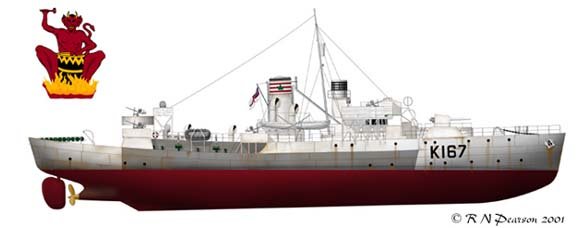
Someone put together a great image of the Drumheller with the badge.

This is the Drumheller in port. The photo’s title was ‘Drumheller Grounded,’ so I wonder if this was after the war when she was being broken up? They scrapped her in Hamilton in 1949, I read.
– – –
I’m sorry that I don’t have more to put up. When I do, I will. Remembrance Day is something I take very seriously, as I have written here and here. I urge everyone to think long and hard about the sacrifices made in years and lives so that you and I can live in the world that we do. Honour those who have done what will never be asked of you and I. Remember them, respect them, and never forget what they have done for us.
Thank you.


Leave a Reply to My 100th Blog Post: Faceintheblue, 100,000 Readers and Counting « Face in the BlueCancel reply